

.webp)

Ever scratched your head over a tiny tip, a parking fee, or a quick Wi-Fi charge from a business trip? Individually, these incidentals seem negligible. Collectively, they morph into a significant financial drain and a compliance nightmare.
For financial controllers, these easily overlooked charges trigger outsized headaches. They fuel the dreaded receipt chase, consume valuable time, and directly blind your real-time financial visibility.
But managing them is simpler than you think. This guide demystifies incidental expenses, breaks down crucial IRS rules, and equips you with modern expense management tips to turn a common administrative headache into a seamless operation.
What are Incidentals?
Corporate vs. IRS Incidental Definition
When defining incidental expenses, you must separate the everyday corporate definition from the very strict definition used by the IRS.
1. The Everyday Corporate Definition
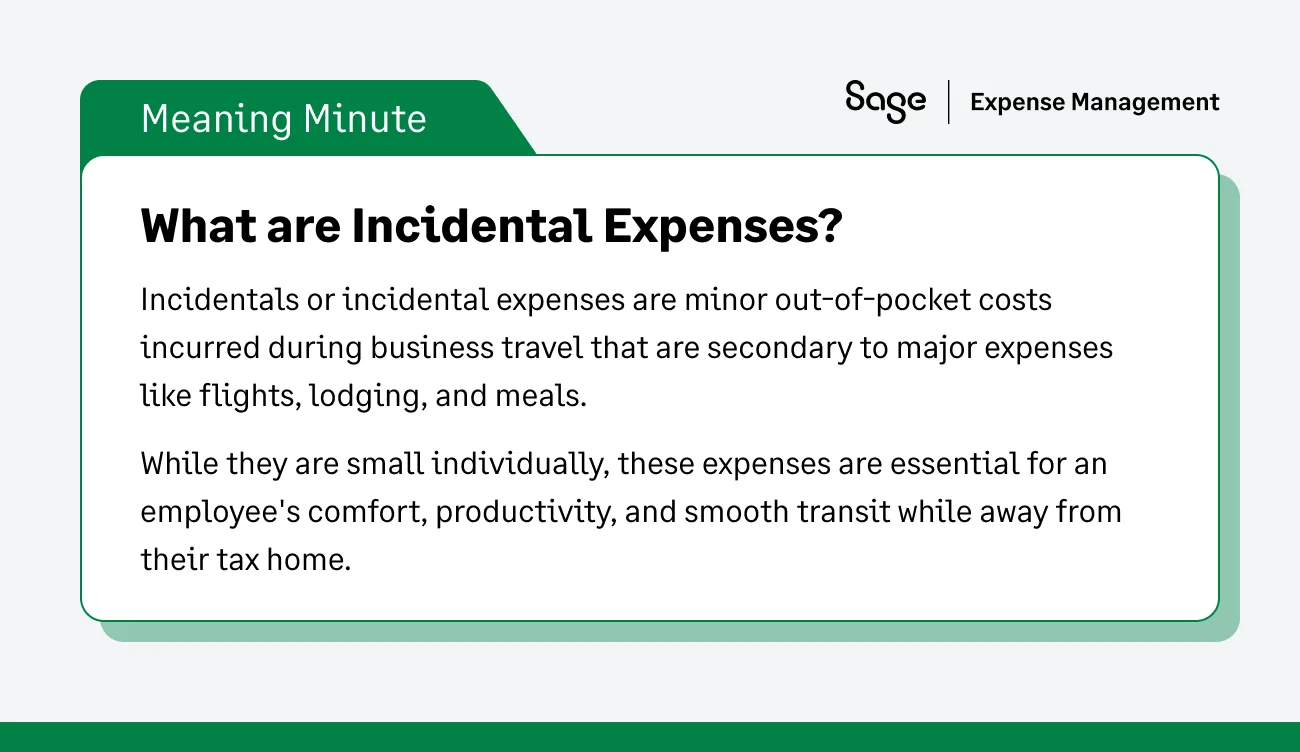
Broadly, corporate finance teams view incidental expenses as the minor out-of-pocket costs incurred during business travel that are distinct from major expenses like lodging and meals. Think of them as the supporting cast of your travel budget, small but essential for comfort and productivity.
2. The Strict IRS Definition
For per diem and tax substantiation purposes, the IRS has a very narrow definition. According to IRS Publication 463, Incidental expenses only refer to fees and tips paid to porters, baggage carriers, bellhops, and hotel or ship staff.
Examples of Incidentals
To ensure accurate tax reporting and policy enforcement, here is how you should categorize these small costs:
True IRS Incidentals (Under Per Diem Rules)
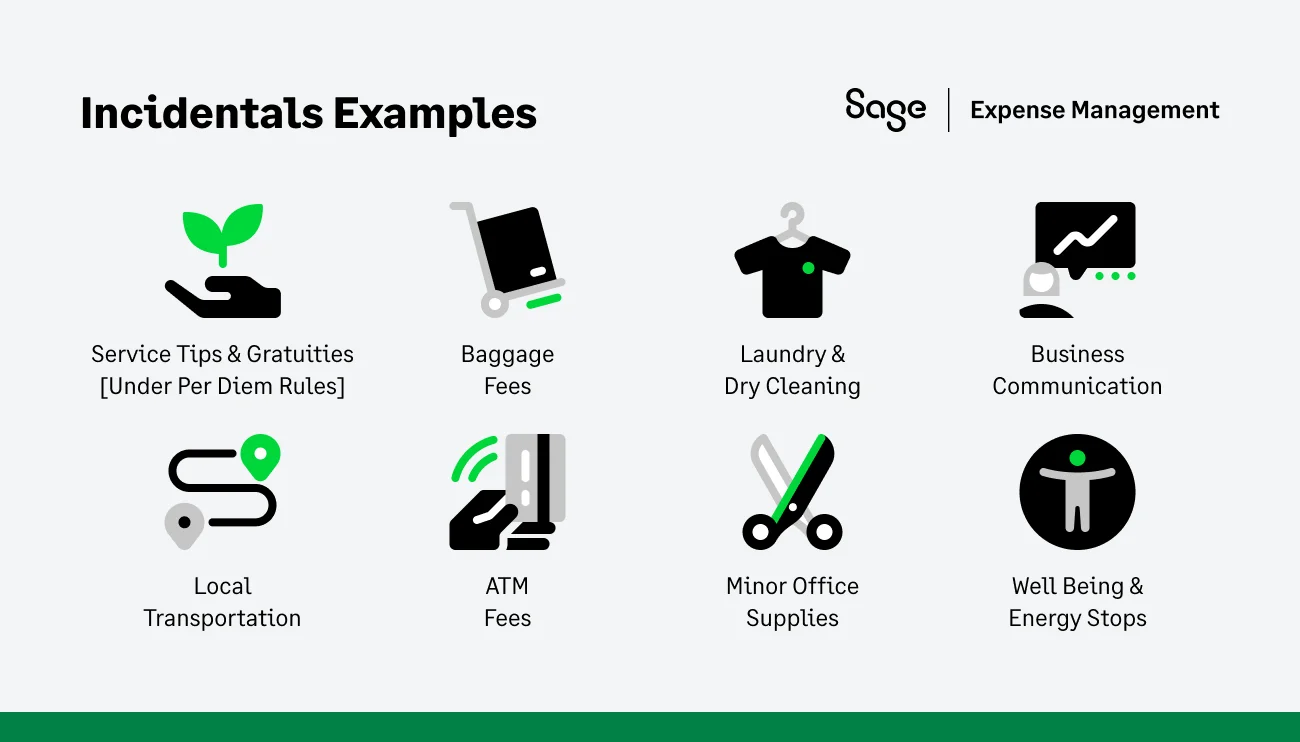
Tips: Gratuities given to hotel housekeeping, bellhops handling luggage, or porters at airports/train stations.
Travel Incidentals (Deductible as separate business expenses)
While the IRS excludes the following from the incidental per diem bucket, they are still deductible as standard travel expenses if properly substantiated:
- Baggage fees: Charges for checked luggage on flights.
- Laundry & dry cleaning: Essential for maintaining a professional appearance during extended trips.
- Business communication: Costs for essential phone calls, faxes, or hotel internet access fees.
- Local transportation: Small fares for local taxis, public transit, or rideshares used to get between the hotel and meeting locations.
- ATM fees: Charges incurred for withdrawing cash specifically needed for business expenses.
Often Overlooked Incidental Expenses
These are the tiny costs that often slip through the cracks but can accumulate:
- Minor office supplies (e.g., pens, notebooks) purchased on the go for unexpected business needs.
- Small charges for hotel gym access or other amenities if directly related to maintaining well-being for business continuity.
- Small convenience store purchases (e.g., bottled water, a snack) directly related to maintaining focus or energy for business activities.
IRS Rules for Deducting and Substantiating Incidentals
Navigating the tax landscape for incidental expenses requires precision. Understanding the IRS's specific stance is vital for ensuring deductibility and avoiding audit panic.
Are Incidental Expenses Deductible?
Yes. According to IRS Publication 535, to qualify as a deduction, the expense must be an ordinary and necessary business expense incurred while traveling. It doesn't have to be indispensable, but it cannot be lavish or extravagant.
The $75 De Minimis Rule & The Burden of Proof Trap
A critical rule simplifies documentation for many incidental expenses: documentary evidence (like a physical receipt) is not strictly required for individual travel expenses under $75 (excluding lodging).
The Trap: This does not mean you don't need a record. The IRS places the burden of proof entirely on the taxpayer. Even if the expense is $12, a credit card statement alone is legally insufficient during an audit. You must still log the amount, time, place, and business purpose.
Want to get better clarity into the $75 rule? Read our article on IRS recordkeeping now!
The Standard $5/Day Incidental Rate
If you want to eliminate the headache of tracking $2 cash tips entirely, the IRS allows employers to offer a flat incidental per diem. If an employee is traveling but not paying for their own meals (e.g., meals are fully catered at a conference), they can claim a standard $5 per day for incidental expenses, as set by the GSA. No receipts or detailed logging of individual tips are required.
The OCONUS/International Nuance
You might wonder why laundry is considered an incidental expense abroad but not at home. The answer lies in how the rules change depending on where your employees travel.
For domestic travel within the contiguous United States (CONUS), the IRS treats laundry and dry cleaning as separate business travel expenses.
However, if your employees travel internationally or outside the contiguous US (OCONUS), the State Department and Federal Travel Regulations lump laundry and dry cleaning directly into the incidental portion of the per diem allowance.
This means what counts as an "incidental" expands the moment your employee crosses the border.
The NY State Split: Customizing Per Diems
Federal guidelines are a ceiling, not a floor, which perfectly explains why lunch is never considered an incidental in New York. Organizations can customize these rules to tighten their budgets.
For example, the New York State Comptroller's Office explicitly states that NYS does not reimburse employees for lunch. Therefore, lunch is completely removed from their Meals & Incidental Expenses (M&IE) breakdown.
Furthermore, New York State refuses to reimburse incidental expenses separately from the standard M&IE allowance. If you want better budget control, take a page from state governments: you can be more restrictive than the IRS, but never less.
The Sleep or Rest Qualifier: When Do These Rules Actually Apply?
Before you start categorizing expenses, there is a major caveat you must consider: When does the IRS actually consider an employee to be on a business trip?
Because incidental expenses are legally tethered to business travel, they are governed by IRS Topic No. 511. You cannot claim travel incidentals for just any out-of-office errand.
The IRS explicitly states that travel expenses (and therefore, travel incidentals) only apply if the employee is traveling away from their tax home for a period "substantially longer than an ordinary day's work" AND they "need to get sleep or rest."
Simply put: A quick day trip across town for a meeting does not qualify for travel incidental deductions. To claim these specific expenses, the trip must require a layover, an overnight stay, or a mandated period of sleep or rest.
The Reality of Paying for Incidentals (Cash vs. Card vs. Per Diem)
The method an employee uses to pay for incidental expenses significantly impacts the ease of tracking and substantiation.
Cash
- Pros: Required for most true IRS incidental expenses (like tipping a bellhop).
- Cons: There is no digital record. This relies entirely on the employee remembering to log the expense, making it the biggest contributor to the receipt chase.
Corporate Credit Cards
- Pros: Automatically creates a digital record of the transaction amount and merchant.
- Cons: You still need a system to capture the business purpose to satisfy the IRS burden of proof.
Per Diem Allowance (M&IE)
- Pros: Immensely simplifies accounting. If you provide an IRS-compliant Meals & Incidental Expenses (M&IE) allowance, employees are not required to keep receipts for those items up to the federal rate.
- Cons: Still requires employees to capture the itemized receipt (if over $75 or lodging) to verify the nature of the purchase. This can still lead to missed receipts and the ongoing receipt chase if not managed efficiently.
{{reduce-paper-receipts="/did-you-know-cards"}}
The 5 Biggest Challenges in Managing Incidental Expenses
Despite their small size, incidental expenses create disproportionately large management headaches:
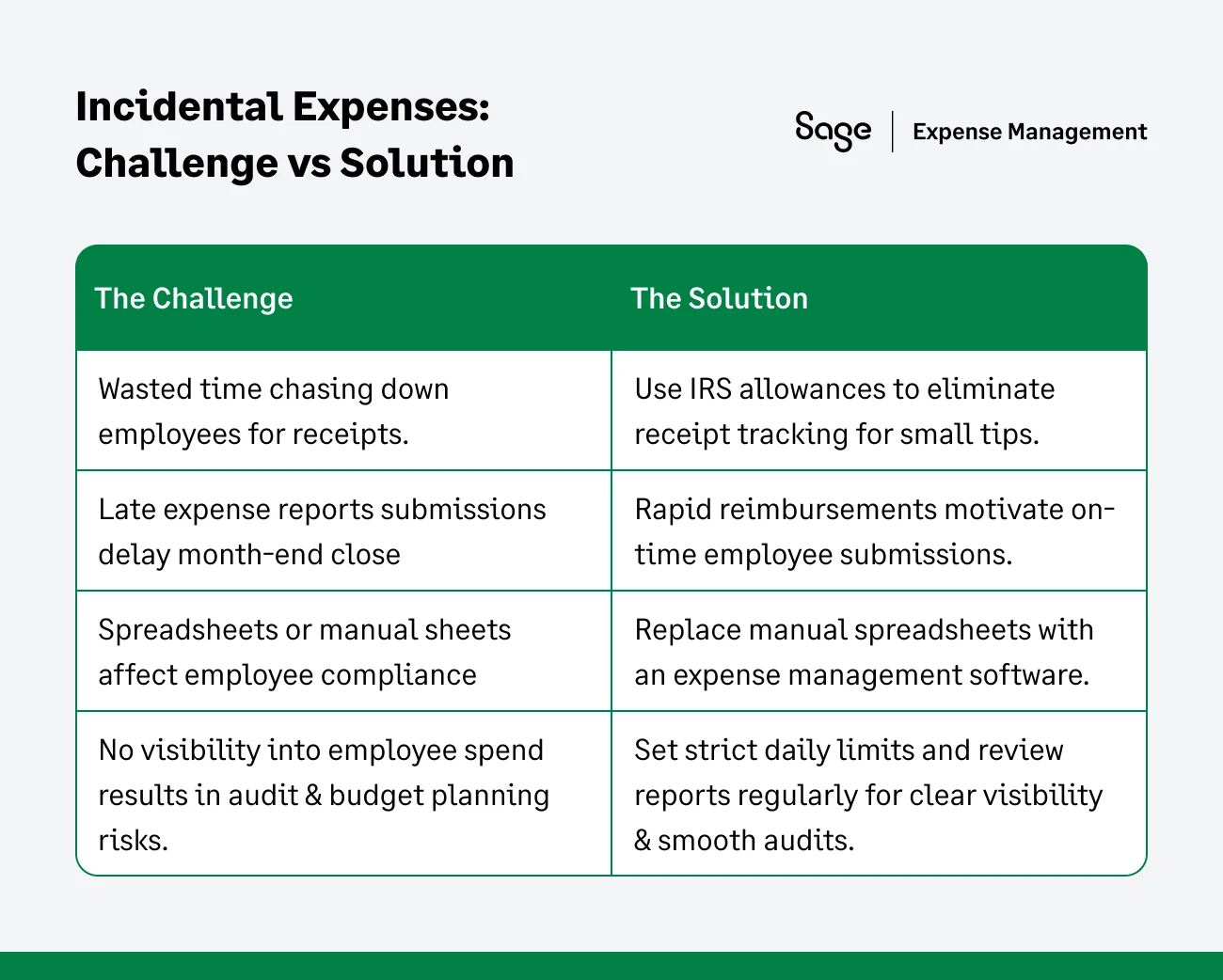
- The receipt chase: Employees overlook small receipts or deem them unimportant. Finance teams waste hours tracking down $5 coffee receipts to close the month.
- Late submissions & delays: Because the amounts are small, employees procrastinate, delaying the month-end close.
- The nuisance factor: For employees, downloading clunky apps and filling out long forms for a $4 parking toll is a disproportionate nuisance. This friction leads to low compliance.
- Lack of visibility: Aggregating numerous small expenses from various trips is a manual nightmare that only automated expense management software can effectively untangle. Thousands of dollars bleed out through uncategorized miscellaneous spending.
- Audit panic: Reimbursing small, unverified spend without capturing the business purpose creates a massive tax liability and compliance risk during an audit.
6 Tips to Master Incidental Expense Management
Proactive strategies can transform incidental expense management from a burden into an efficient process:
- Establish clear policies: Define precisely what qualifies as an incidental expense and set reasonable daily spending limits.
- Ensure timely kept records: The IRS emphasizes that records should be maintained at or near the time of the expenditure. Mandate real-time logging.
- Leverage M&IE per diems: Use IRS-approved meals & incidental expenses (M&IE) allowances to eliminate the need for individual receipt tracking on meals and tips.
- Ensure rapid reimbursement: Rapid reimbursement motivates employees to submit reports accurately and on time.
- Conduct regular audits: Periodically review expense reports to catch policy misuse and maintain financial discipline.
- Provide expense tracking tools: Ditch manual spreadsheets and equip your team with expense management tools that remove the administrative burden.
When dealing with incidental expenses, the administrative cost of manual tracking often outweighs the financial value of the expense itself.
Shifting from manual policy enforcement to automated expense management is the only realistic way to maintain compliance at scale without burning out your finance team.
How Sage Expense Management Eliminates the Incidental Headache
Sage Expense Management is uniquely positioned to transform the annoyance of incidental expenses into a seamless, compliant process.
Eliminate the Receipt Chase with SMS Capture
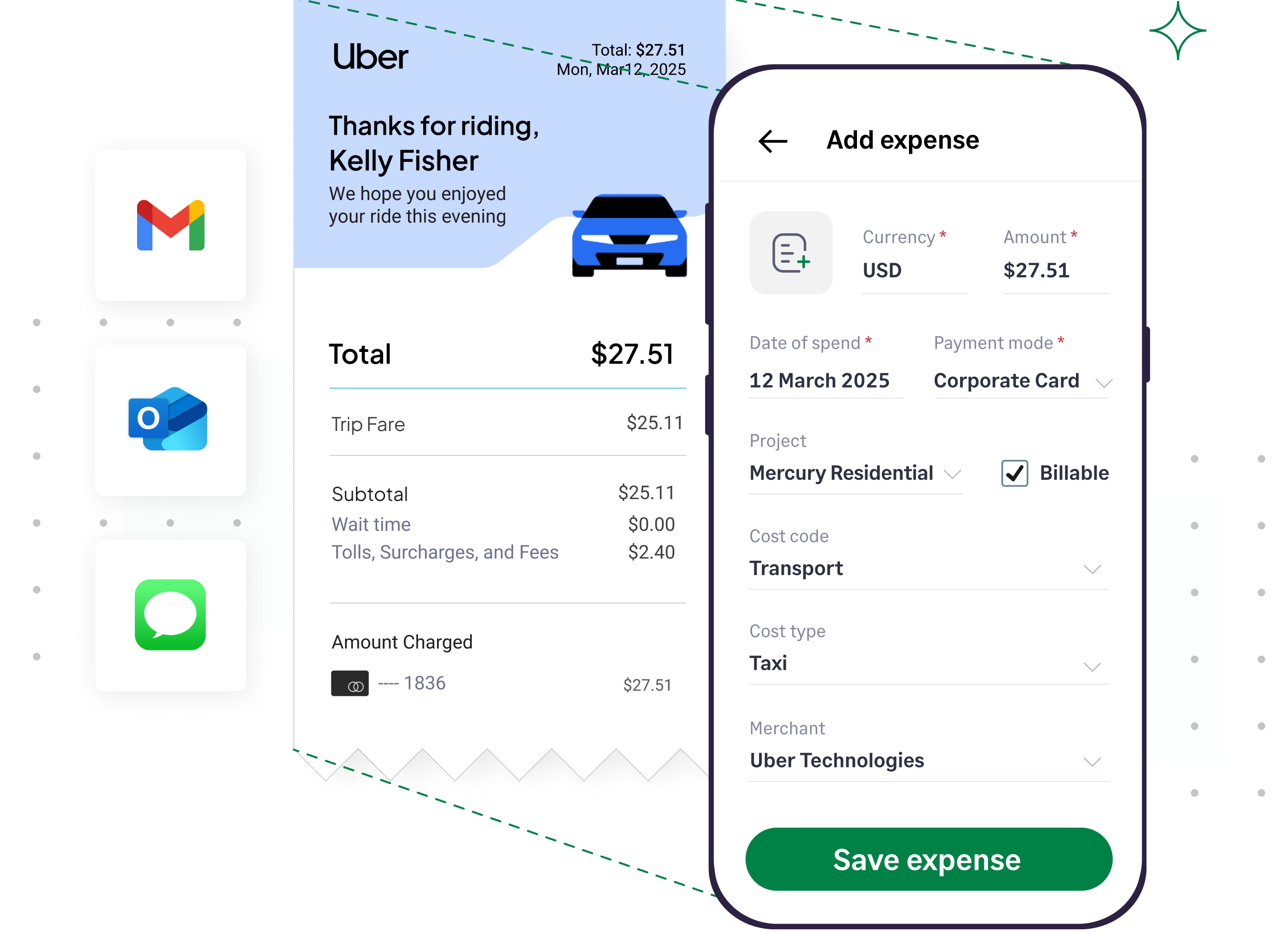
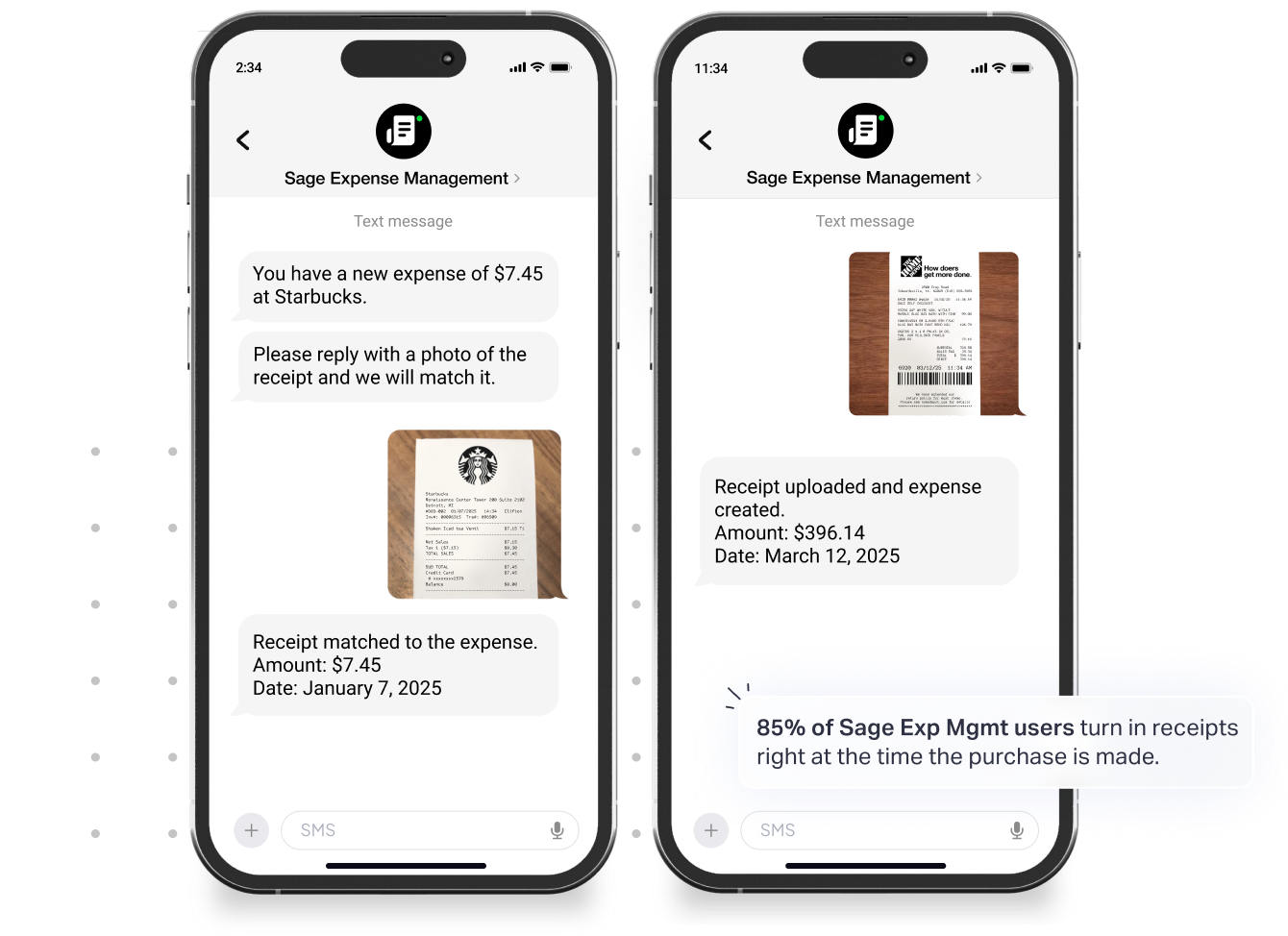
Employees shouldn't have to navigate a complex app for a $5 expense. Sage expense management allows your team to submit receipts using tools, they already rely on daily.
They can simply submit receipts via text message, or instantly forward digital receipts directly from their email (including Office 365 and Gmail). The AI using OCR technology automatically extracts the merchant, date, and amount, matching it to the right transaction and killing the receipt chase for good.
Real-Time Card Feeds
Say goodbye to the 30-day wait for credit card statements. Sage Expense Management connects directly to your existing Visa or Mastercard.
The second an employee swipes their corporate card for a $5 coffee or a Wi-Fi charge, that transaction data instantly appears on your finance dashboard. You get 100% visibility and control over incidental spending exactly as it happens.
Audit-Ready Digital Trails
Sage Expense Management solves the burden of proof trap by prompting the employee to input the business purpose at the exact point of capture. This centralizes expenses into a secure, unalterable digital record, ensuring you are 100% audit-ready.
Proactive Budget Controls
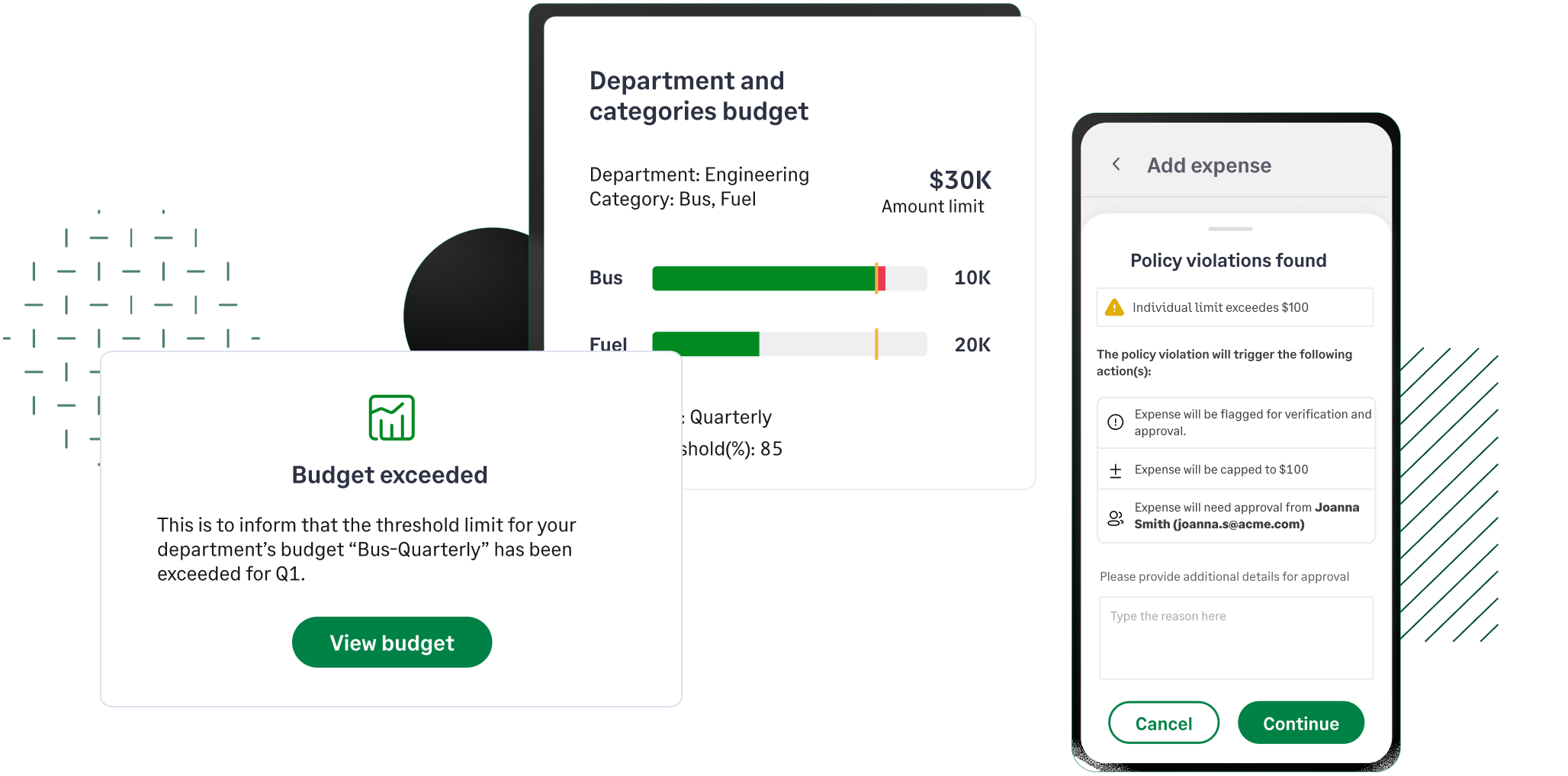
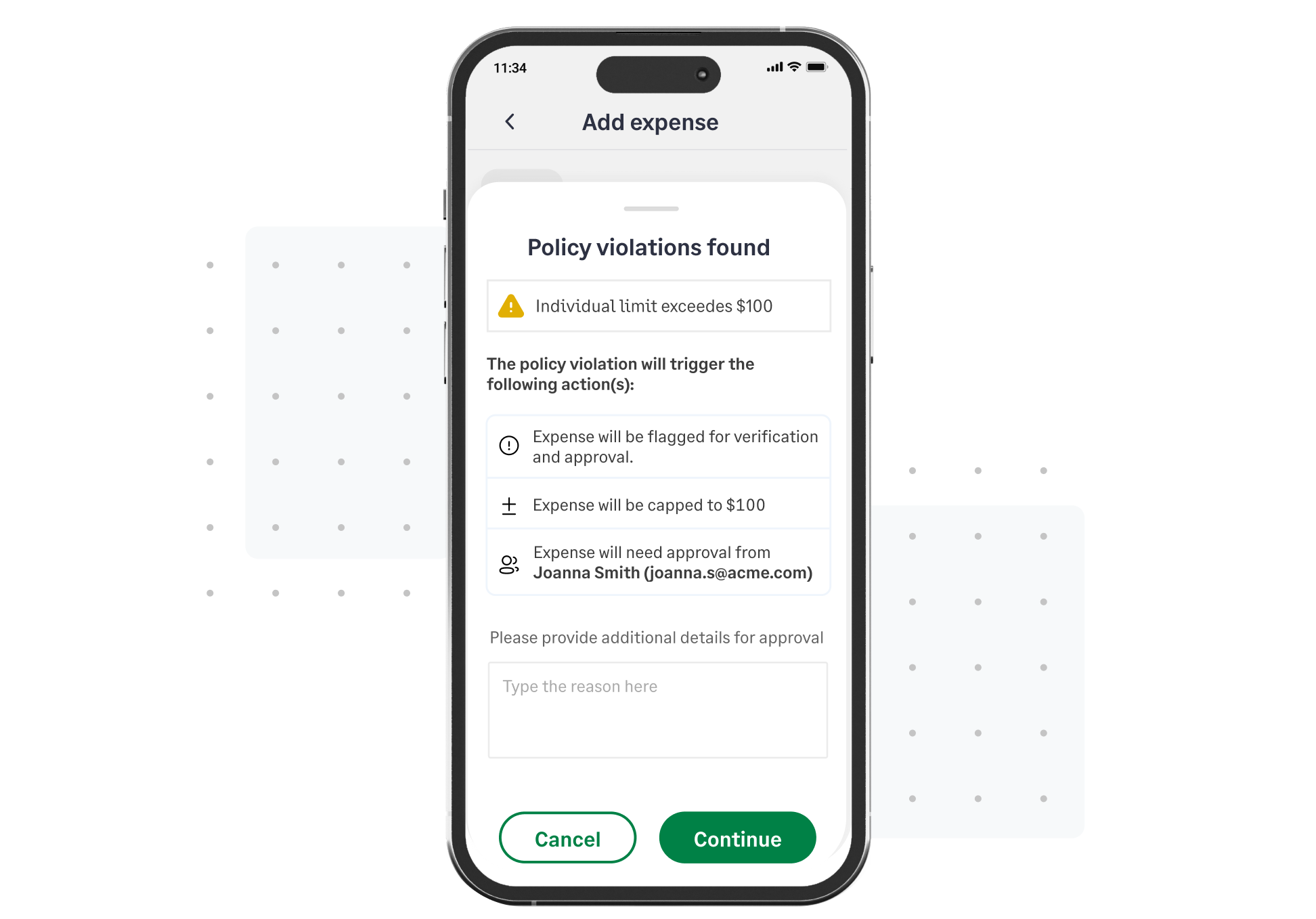
Stop employees from nickel-and-diming the company. Sage Expense Management’s hyper-granular budget features allow you to set strict limits on categories like "Meals & Incidentals" for specific projects or departments, automatically flagging out-of-policy spend before it's reimbursed.
Incidental expenses may be the smallest line items on your travel budget, but relying on manual spreadsheets, paper receipts, and human memory to manage them will cost your finance team dearly in wasted hours and compliance risks.
By understanding the strict IRS rules, leveraging per diems where appropriate, and replacing the manual "receipt chase" with frictionless automation, you can regain complete financial visibility and control. It’s time to stop chasing down $5 coffee receipts and start focusing on strategic financial growth.
{{incidentals="/cta-banners"}}
.jpg)