

Dear SMB Owner,
Your time is too valuable to spend manually reconciling expenses.
There are 4 things your finance team needs to know about modern expense reporting:
- Audit readiness is non-negotiable: Reports are the primary evidence that protects your company during an IRS examination (the burden of proof is always yours).
- Automation is mandatory for growth: Manual processes cannot scale and cost thousands in wasted time and processing errors.
- Compliance must be real-time: Waiting until month-end exposes you to tax liability under the IRS Nonaccountable Plan rules.
- Your data must be perfect: Expense reports must provide accurate, fully coded data for general ledger posting, project tracking, and financial analysis.
Sincerely,
Every Finance Team.
How to Create an Expense Report Manually
For many companies, the process of creating an expense report starts and ends with a spreadsheet. While easily accessible, manually generating a report requires rigorous attention to detail to ensure it meets both internal policy and IRS compliance standards.
1. Choosing Your Template and Customizing Columns
You can easily find a downloadable expense report template online or in Microsoft Excel. However, a generic template is often insufficient for auditable records. You must tailor your report to capture specific business data points.
- Essential data: Every report needs columns for the Date, Merchant, Amount, Payment Method, and Name/Contact Information of the submitter.
- Compliance & accounting data: You must edit columns to include fields for Business Purpose, GL Code/Category, and, where necessary, Project/Job Code to ensure accurate posting and deductibility.
2. Adding Expenses and Itemization
This is the most time-consuming task for the employee. They must transfer details from each transaction record onto the report.
- Manual entry: Each business expense—whether for transportation, meals, or travel—must be recorded one line at a time.
- Split expenses: If a single receipt covers multiple GL codes or cost centers, you must accurately itemize and split the expense line by line, calculating the correct deductible percentage (e.g., 50% for standard meals).
3. Calculating Totals and Tax Deductions
Accuracy in this stage is critical for timely month-end close.
- Total calculation: Sum all expense amounts, ensuring personal portions (if any) are excluded.
- Deductible limits: Manually apply tax rules, such as the 50% deduction limit for most business meals. If tracking mileage, confirm the correct Standard Mileage Rate for the reporting period (e.g., 76 cents/$0.76 per mile for H2 2026).
4. Attaching Receipts and Finalizing the Report
This step determines if your report is compliant under the IRS Accountable Plan.
- The documentation mandate: You must attach documentary evidence (receipts) for all expenses, especially those of $75 or more (excluding lodging).
- Timely submission: For an expense report to maintain its non-taxable status, the employee must provide adequate accounting—meaning the receipt and details must be reported within a reasonable time (typically 60 days after the expense).
- Final delivery: The employee prints the entire packet (spreadsheet and all receipts), signs it, and physically or digitally sends the report to the manager for approval.
The IRS Checklist: What Your Expense Report MUST Prove

To protect your business from audit risks and maintain an Accountable Plan, every expense report must contain Adequate Records (documentation) submitted Timely.
Your expense management system must be able to capture and retain the following six essential elements for every single transaction:
1. Amount
For expenses $75 or more (excluding lodging), documentary evidence (receipts or canceled checks) is mandatory for tax substantiation, as the IRS does not allow approximated amounts.

2. Time (Date)
The date of the expense must be recorded at or near the time it was incurred (e.g., daily or weekly log) to be considered reliable. This satisfies the 60-day accounting window required for an Accountable Plan, ensuring reimbursements are non-taxable.
3. Place/Description
The full name and location of the merchant (e.g., restaurant or hotel) must be clearly recorded. For lodging, this includes dates stayed and separate amounts for charges to satisfy IRS documentary requirements.
4. Business Purpose
A written statement of business purpose is necessary to prove the expense is "ordinary and necessary." For meals, this includes the names and business relationships of guests to determine deductibility.
5. Categorization
Accurate classification of the expense to the correct GL Account, Class, Project, or Cost Center is crucial for timely financial reporting and determining deductibility (e.g., separating deductible repairs from capitalized assets).
6. Substantiation
Documentary evidence (the actual receipt) must be attached as digital proof. This is essential for meeting the burden of proof and protecting the company from disallowances during an audit.
A modern expense reporting solution centralizes these complex compliance rules, eliminating manual work and ensuring every report is audit-ready on submission.
The True Cost of Manual Expense Reporting
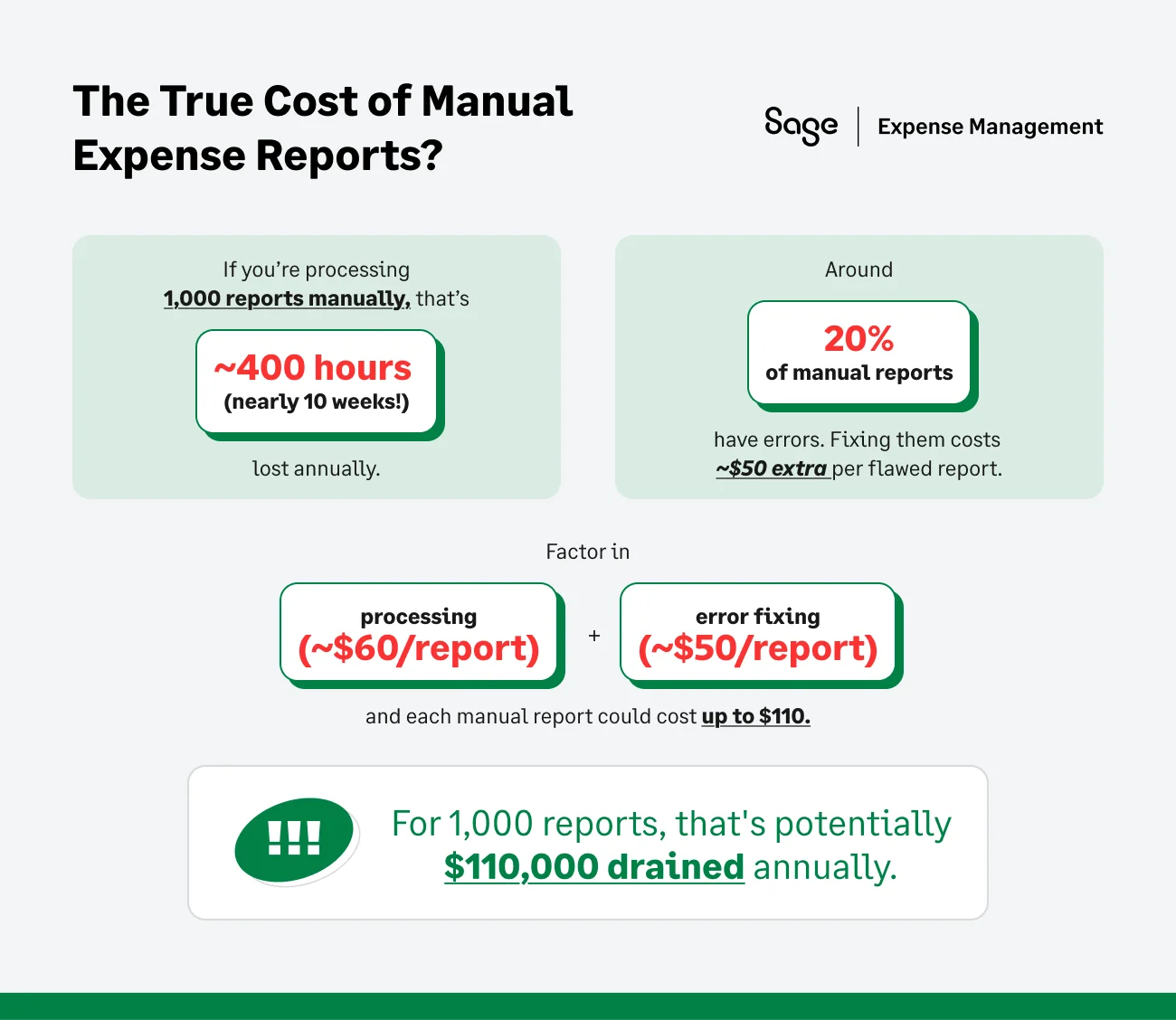
Even if you have a great Excel template, manual reporting creates a cycle of unproductive, time-consuming tasks for every stakeholder. This "hot mess" is a serious business risk.
The Employee's Burden (The Barrier to Compliance)
Manual systems create friction, leading to lost receipts and late submissions:
- Chasing, saving, and physically securing paper receipts.
- Manually entering data, often struggling to correctly code expenses to GL accounts or projects.
- Facing delays or policy flags after the expense is incurred (when they no longer have the receipt in hand).
- Chasing finance for delayed reimbursement (which demotivates users).
The Finance Team's Burden (The Risk)
For finance teams, the manual process is where compliance and control break down:
- Wasted time: Hours spent manually verifying paper and digital receipts—a task that can take 5–6 hours per cycle and is rated as the strongest time drain.
- Compliance threat: Exposing the company to Nonaccountable Plan liabilities by failing the IRS’s 60-day deadline for adequate accounting.
- Inaccurate books: Inaccurately matching expenses to the correct GL codes, classes, projects, or cost centers.
- Zero visibility: Flying "blind till the end of the month", making it impossible to proactively manage budgets or detect fraud.
How Sage Expense Management (formerly Fyle) Makes Expense Reports Audit-Ready
Sage Expense Management eliminates this manual burden by automating the most critical elements of reporting and compliance, turning a multi-hour process into mere minutes.
1. Eliminating Manual Entry and Receipt Chasing
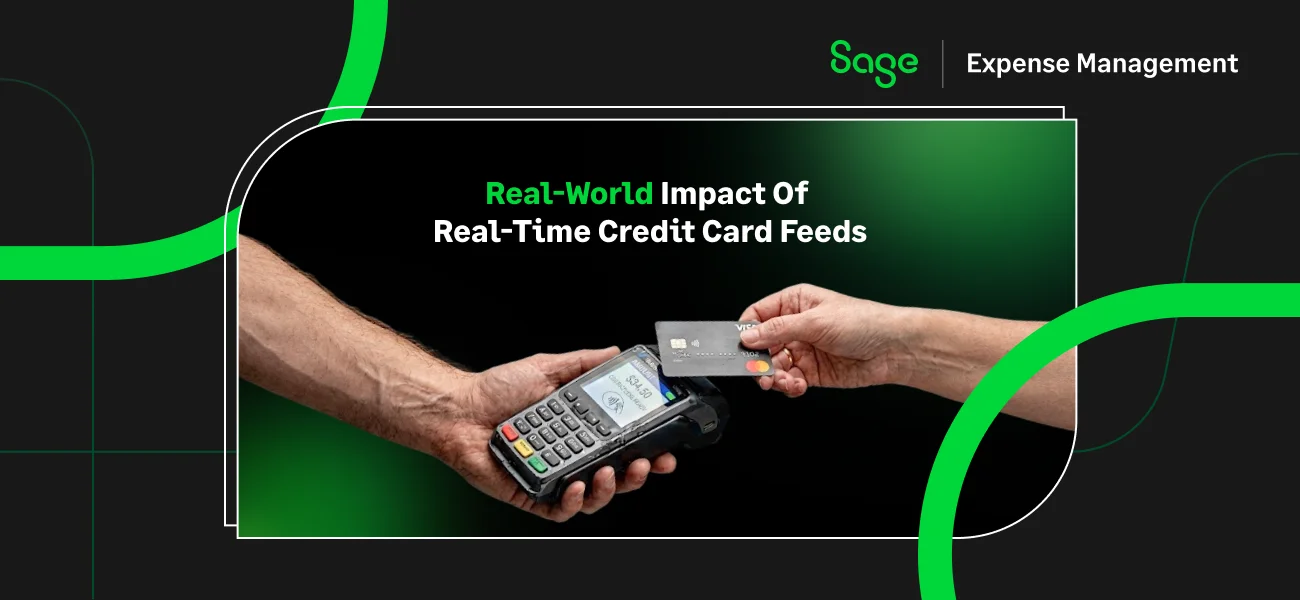
- Real-time feeds (RTF): Stop relying on monthly statements. Sage Expense Management uses direct card network feeds (Visa, Mastercard) to log the transaction instantly upon swipe.
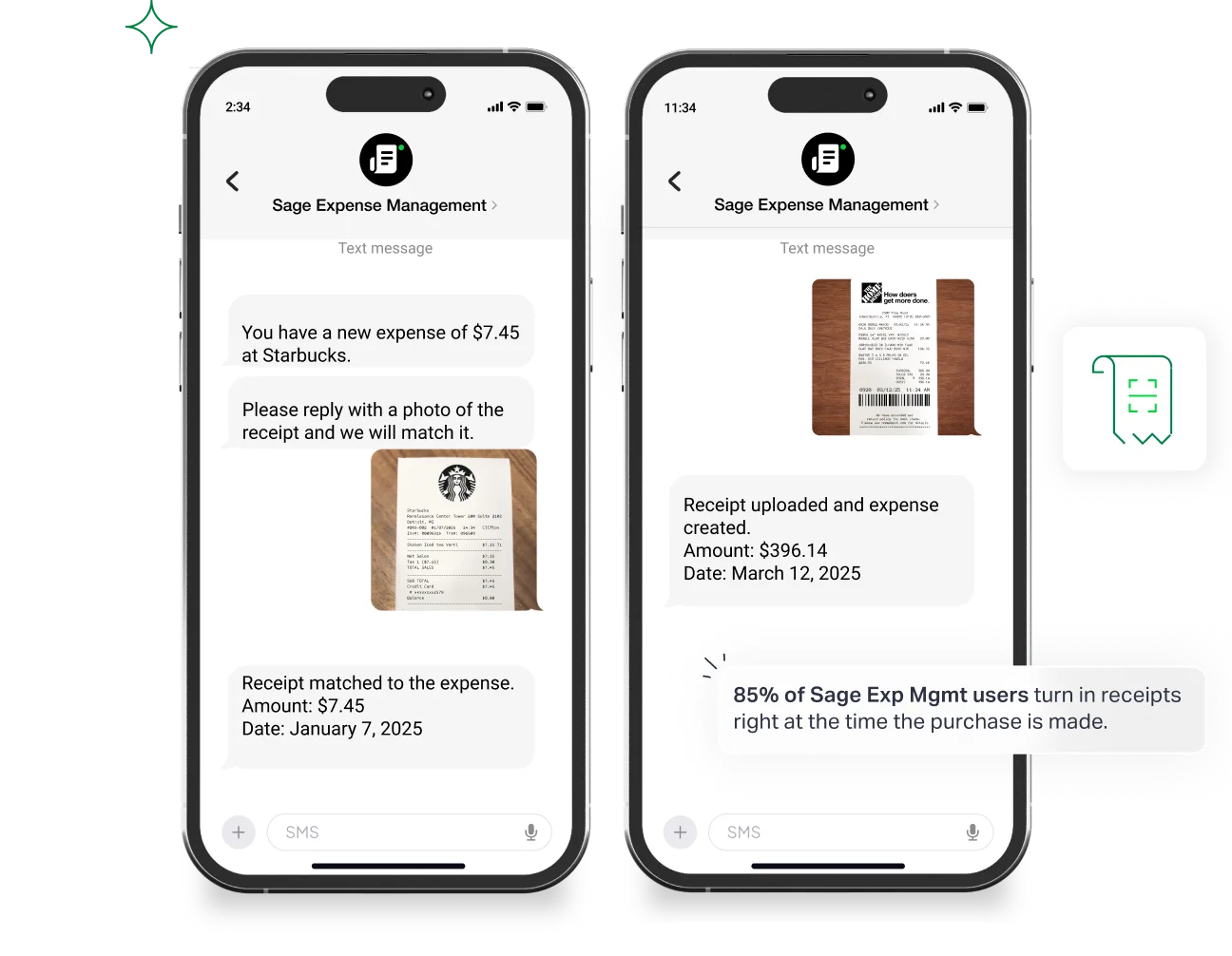
- Instant receipt collection and reconciliation: The employee receives a text notification the moment the credit card charge is made. They simply reply to the text with a picture of the receipt to attach it—no app login required. This ensures real-time substantiation, guaranteeing compliance with the 60-day rule.
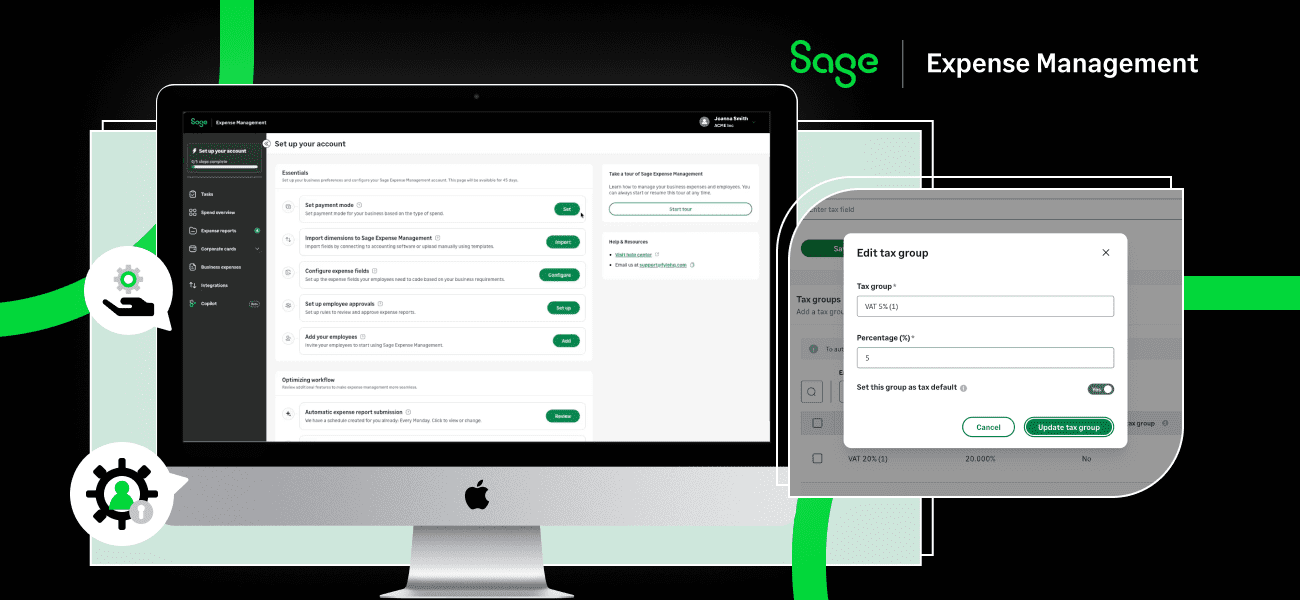
- Smart categorization: Our AI-Powered OCR instantly extracts the amount, date, and merchant. Dependable Fields guide the user to select the precise GL, Project, or Cost Center code based on your pre-set logic, ensuring accurate accounting upfront.
2. Automated Reporting, Policy Enforcement, and Export
- Auto-report submission: You set the frequency (weekly, bi-weekly, or monthly statement cycle). The system automatically collects all complete expenses, generates the formal report, and submits it to the appropriate manager.
- Policy-driven approvals: Real-time checks flag expenses that violate pre-set policies (e.g., spending over a specific budget or exceeding the meal limit). This allows you to enforce control before the expense is posted to the ledger.
- Audit-ready export: Once approved, the report—complete with the expense record and the digitally secured receipt image—is seamlessly synchronized to your accounting system (QuickBooks, Sage Intacct, etc.) for instant, clean reconciliation.
With Sage Expense Management as your expense reporting software, you can eliminate manual frustration and ensure every expense is audit-proof.
Don’t believe us? Allow us to demonstrate how you can achieve reconciliation in under 2 minutes. Schedule a demo now!
{{expense-reporting="/cta-banners"}}