In Delaware, understanding mileage reimbursement involves looking at federal guidelines, specific state rules for public employees and workers' compensation, and common practices among private employers.
For businesses and employees in Delaware, knowing these rates and rules is crucial for ensuring fair compensation and maintaining compliance.
Delaware Mileage Reimbursement Rate
The most frequently referenced standard for business mileage reimbursement is the rate set by the Internal Revenue Service (IRS). For 2026, this rate changed mid-year: the IRS set the business rate at 72.5 cents per mile for the first half of the year, then raised it to 76 cents per mile effective July 1, 2026.
While Delaware private employers are not generally mandated by a specific state law to use the IRS rate for all business mileage, many choose to do so because:
- It provides a nationally recognized standard calculated to reflect the average costs associated with operating a vehicle for business, including fuel, maintenance, insurance, and depreciation.
- Reimbursements made at or below the current IRS standard business rate are generally non-taxable income for the employee, provided that proper and accurate records are maintained.
- It offers a consistent and transparent method for compensating employees fairly for the business use of their personal vehicles.
For 2026, the standard IRS mileage rates are different for H1 and H2.
For H1 2026 (Jan - June):
- Business Use: 72.5 cents per mile
- Medical/Moving: 20.5 cents per mile (Note: Moving expenses deduction is generally only available for active-duty military members)
- Charitable: 14 cents per mile
For H2 2026 (July - Dec):
- Business Use: 76 cents per mile, up 3.5 cents from H1 2026.
- Medical/Moving: 23.5 cents per mile, up 3 cents from H1 2026. (Note: Moving expenses deduction is generally only available for active-duty military members)
- Charitable: 14 cents per mile, no change.
Other relevant rates in Delaware include:
- Delaware State Employee Rate: The State of Delaware sets a specific mileage reimbursement rate for its state employees who use personal vehicles for official business. This rate is currently 50 cents per mile since July 2023.. This rate is established by the Department of Human Resources, Division of Small Business, with the approval of the Governor, as per Delaware Code Title 29, Chapter 71, § 7102.
For historical context, here are the IRS standard business mileage rates from recent years:
Delaware Mileage Reimbursement Calculator
Simplify your mileage reimbursement calculations with our user-friendly Delaware Mileage Reimbursement Calculator.
How to Use the Calculator:
- Select the correct tax year: Choose the year for which you're calculating reimbursement (e.g., 2025, 2024), as the applicable IRS rates can change.
- Input your business miles: Enter the total number of miles driven for business purposes using your personal vehicle.
- Calculate your reimbursement: The calculator will automatically apply the official IRS standard mileage rate for the selected year and display your estimated reimbursement amount.
This tool provides a quick and accurate estimate, beneficial for both employees needing to claim expenses and employers processing those claims.
Calculate
Results
Some Important Delaware Mileage Reimbursement Laws
While Delaware doesn't have a statewide law mandating mileage reimbursement for all private-sector employees in every instance, several state laws and federal regulations influence how employers should handle these expenses:
1. Delaware Minimum Wage Law
Delaware's minimum wage is $15 per hour as of January 1, 2025.
A critical point for employers is that any unreimbursed business expenses an employee is required to incur, such as mileage for using a personal vehicle for work, should not cause their effective hourly earnings to fall below this state minimum wage threshold for the hours worked in a pay period.
If it does, the employer could be in violation of Delaware's wage laws.
2. Workers' Compensation (Delaware Code Title 19, Chapter 23, § 2322(f))
As noted, Delaware law ensures that employees injured on the job receive reimbursement for necessary travel to obtain medical treatment. The rate for this is set at 50 cents per mile if a private vehicle is used.
3. No General Mandate for Private Employers
Delaware law does not obligate private employers to offer mileage reimbursement for general business use of personal vehicles.
Therefore, a company's internal policy plays a significant role. However, many employers choose to reimburse as a good business practice and to avoid potential minimum wage complications.
4. State Employee Travel Regulations (Delaware Code Title 29, Chapter 71)
The State of Delaware has specific regulations governing how state employees are reimbursed for travel expenses, including mileage.
The Secretary of Finance, with the Governor's approval, establishes these rules to ensure accountability. While not binding on private employers, these regulations underscore a framework for managing travel expenses.
Delaware Mileage Reimbursement Law vs. Federal Law
Understanding the interplay between Delaware's state context and federal laws is essential for proper mileage reimbursement:
Federal Law (FLSA)
The Fair Labor Standards Act (FLSA) is the primary federal law affecting this area. It mandates that employees receive at least the federal minimum wage ($7.25 per hour) "free and clear" of any business expenses incurred primarily for the employer's benefit.
If a Delaware employee's unreimbursed mileage costs effectively reduce their pay below this federal threshold, the employer must provide sufficient reimbursement to meet the minimum wage.
However, since Delaware's minimum wage is significantly higher, compliance with the state minimum usually ensures compliance with the federal minimum in this regard.
Delaware State Law
- Delaware's minimum wage law sets a rate higher than the federal standard, at $15.00 per hour in 2025.
- Specific provisions mandate mileage reimbursement for travel related to workers' compensation medical treatment at 50 cents per mile.
- The state sets a distinct mileage rate of 50 cents per mile for its own employees.
IRS Regulations
The IRS sets the standard mileage rates (e.g., 76 cents/mile for business in 2026) for tax purposes.
These rates are not legal mandates for employers to reimburse but are crucial for determining the non-taxable amount of reimbursement under an accountable plan.
Using these rates helps ensure that reimbursements aren't considered taxable income for employees and are deductible for employers.
In Delaware, the state minimum wage law provides a robust wage floor. State law specifically addresses workers' compensation travel and sets distinct rules for public sector employees.
IRS guidelines then offer a practical framework for the amount and tax treatment of reimbursements, often adopted by Delaware employers for simplicity and tax compliance.
How Sage Expense Management (formerly Fyle) Can Automate Mileage Tracking
Simplify your mileage reimbursement process and eliminate manual efforts. Sage Expense Management offers Delaware businesses an efficient, automated platform to manage mileage expenses accurately.
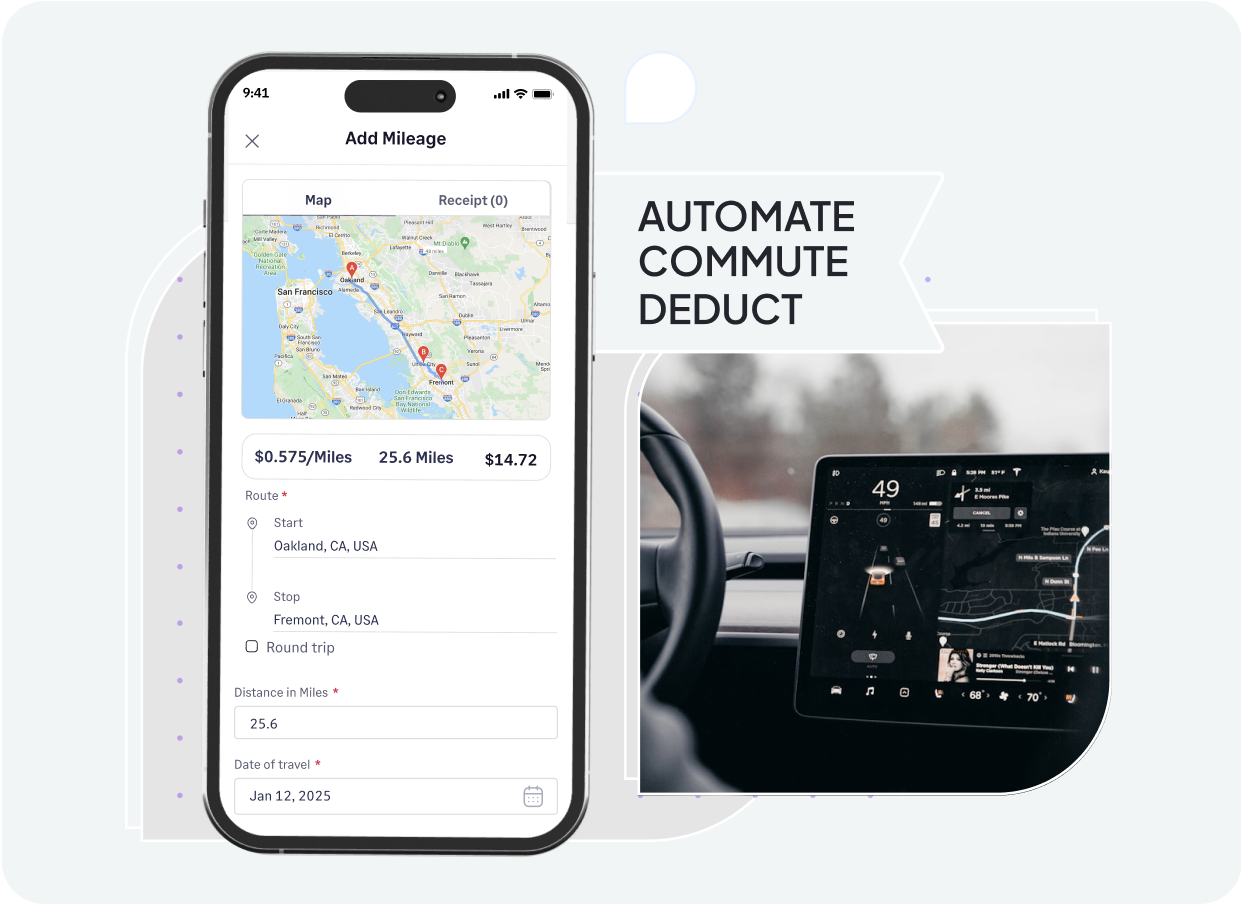
- GPS accurate mileage logging: Automatically captures travel distances using Google Maps for precise records.
- Customizable rate application: Set IRS, state-specific, or unique company rates that apply to claims instantly.
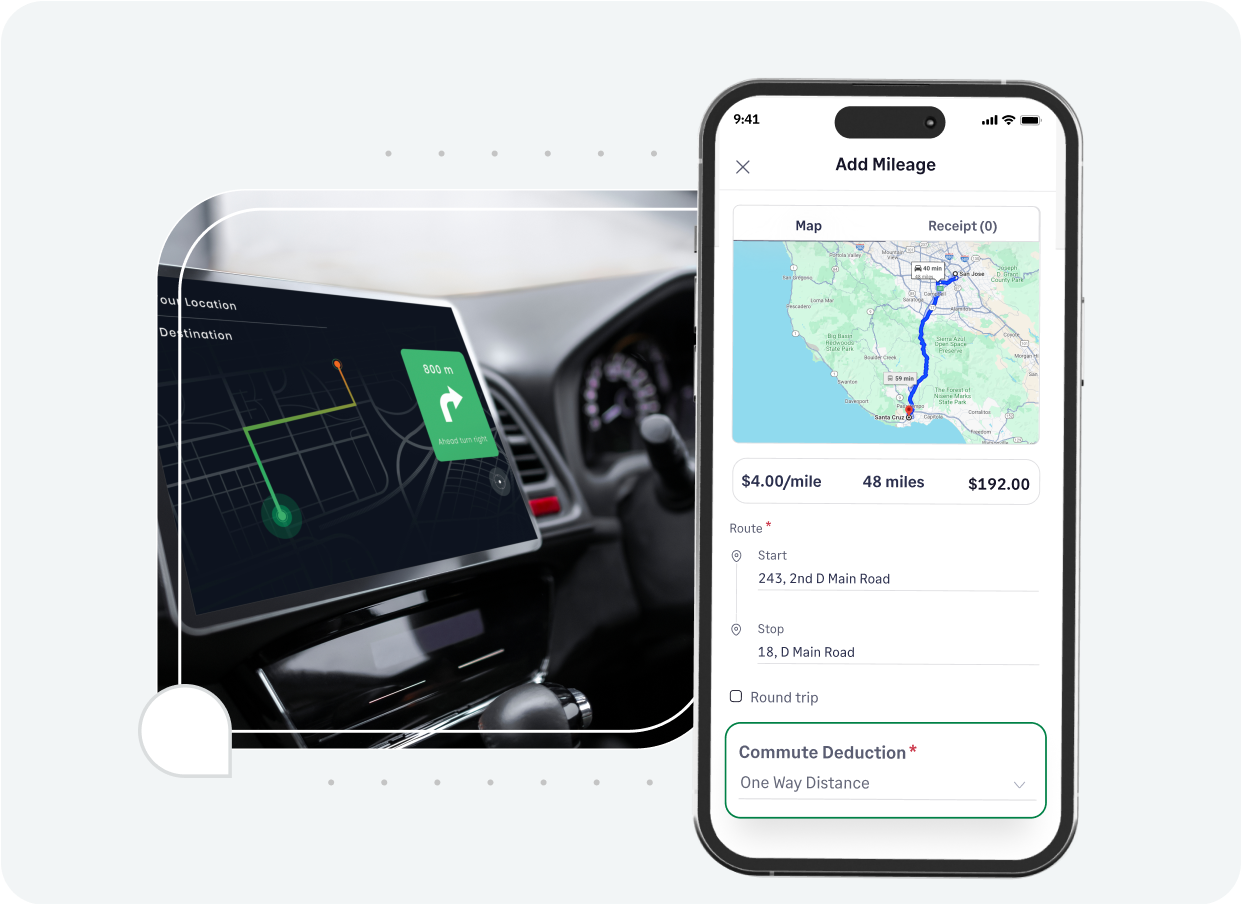
- Easy commute mileage management: Defines home/work locations to accurately deduct non-reimbursable commute travel.
- Automated recurring trip claims: Allows employees to set up frequent routes once for automatic future claim creation.
- Built-in compliance checks: Embed company travel policies to flag any out-of-policy submissions early.
- Seamless accounting system sync: Integrates with QuickBooks, Xero, NetSuite, and others for direct data flow.
- Prompt ACH reimbursements (US only): Facilitates quick direct payments for approved employee mileage claims.
With Sage Expense Management, Delaware companies can streamline their mileage tracking, ensuring better compliance and saving valuable time.